Fact Sheet # 12: Soil pH Response to Lime Source and Incubation Period: A Pilot Study to Guide a National Lime Calibration Project
Soil testing and fertilizer management are at the core of modern agriculture. Most soil test correlation and calibration trials and the corresponding development of fertilizer recommendations occurred from the 1950s to 1970s. Despite advancements in analytical testing, statistics, data management, and agronomy, research on key soil fertility topics has not been conducted in many states. Today, the imperative to improve fertilizer and soil amendment recommendations is highlighted by variable on-farm economic conditions and concerns over the fate of fertilizer nutrients in the environment.
The Fertilizer Recommendation Support Team project, or FRST, is a national initiative to modernize fertilizer recommendations by pooling expertise and soil test correlation and calibration data from across the country into an accessible decision support tool. Researchers working as a national team rather than within individual states and institutions will reduce ambiguity while optimizing soil amendment and nutrient use across state lines. FRST activities also include improving soil acidity management and liming recommendations. The FRST tool and data generated by FRST activities are expected to augment existing recommendations with the potential to enhance soil and natural resource management, increase return on fertilizer and soil amendment investments by growers, and reduce nutrient losses to the environment.
Accurate lime recommendations are essential for managing soil acidity and optimizing nutrient availability. Much of the foundational work supporting lime requirement calibrations was conducted several decades ago, despite major advancements in agronomic practices and yield potential since that time. Updating and harmonizing these recommendations is increasingly important under today’s variable economic conditions and heightened environmental stewardship goals.
This pilot study was conducted to inform a nationwide lime calibration effort. Specifically, the study addressed two key questions: 1) Does soil pH respond similarly when reagent-grade CaCO3 and Ca(OH)2 are applied at equivalent calcium carbonate equivalence (CCE) rates? and 2) What is the minimum incubation period required for each source to produce a stable pH equilibrium?
Three acidic soils supplied by the Agricultural Laboratory Proficiency Program were selected to represent a range of buffering capacities (Table 1).
Table 1. Median soil properties.
| Soil Series (State) | Ipage (NE) | Gilford (IN) | Moody-Nora (SD) |
| Textural class | Sandy loam | Silt loam | Silty clay loam |
| Clay, % | 7 | 20 | 28 |
| Organic matter, % | 1.32 | 2.36 | 5.73 |
| pH1:1 H2O | 4.05 | 5.12 | 5.33 |
| Sikora BpH | 6.61 | 6.70 | 6.14 |
Powdered reagent-grade CaCO3 that passed a 325-mesh sieve or Ca(OH)2 was applied at rates equivalent to 0, 0.25, 0.50, 1, 2, and 4 tons 100% CCE acre-1, assuming 2.0 million pounds of soil per acre at a 6″ depth. Samples were incubated for 4, 8, 16, and 30 days at room temperature and 50% water-filled pore space. Post-incubation soil analyses were performed by Best-Test Analytical Services, LLC (Moses Lake, WA) for water pH1:1, salt pH1:1 (0.01 M CaCl2), EC, water-extractable Ca, inorganic N, and KCl-extractable Al.
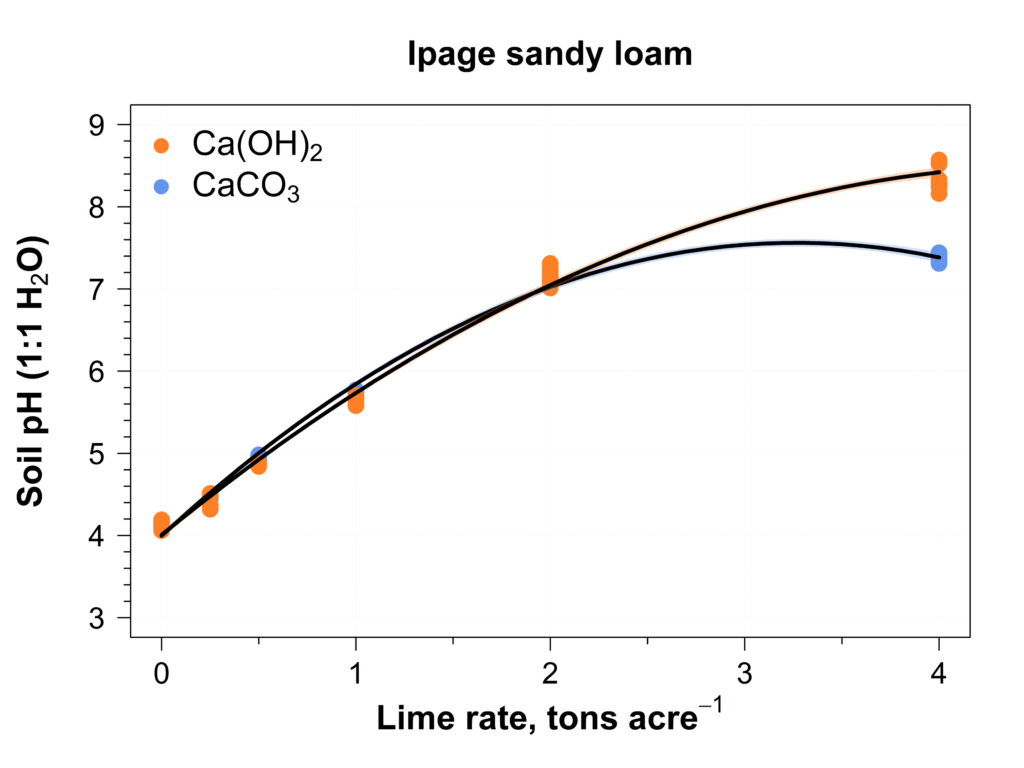
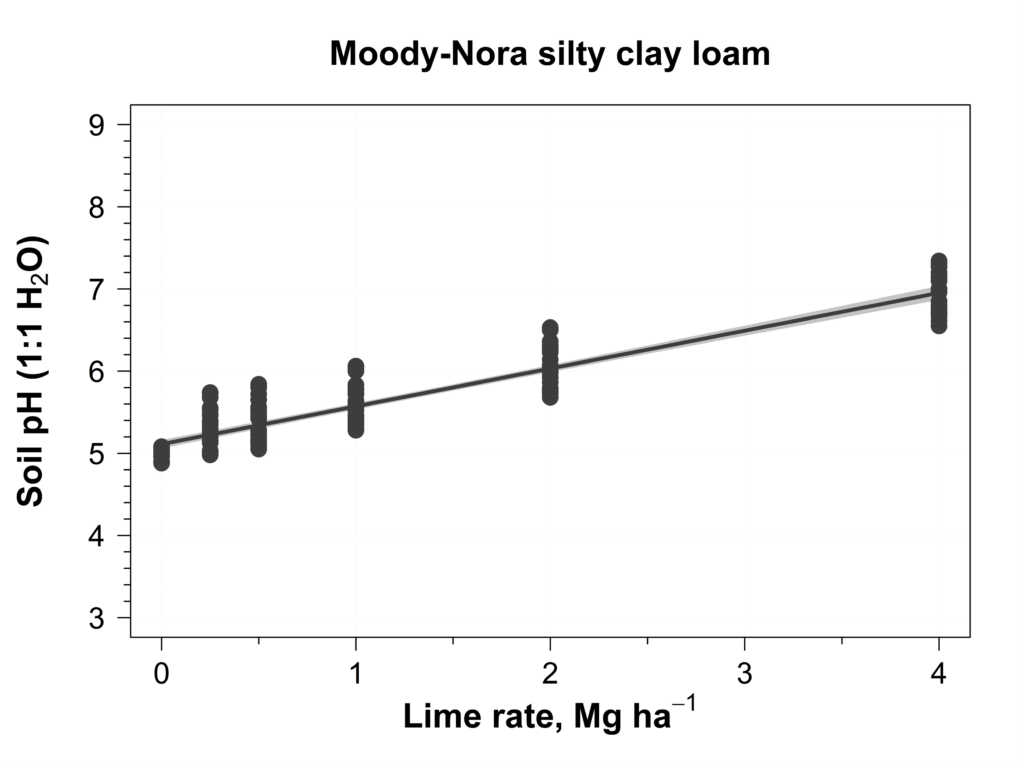
Results from this pilot study can be summarized in four main points:
- Incubation of soil–lime mixtures for 4 to 8 days at room temperature is sufficient to characterize soil pH response to lime rate.
- Soil pH responses were comparable between powdered CaCO3 and Ca(OH)2 when applied at equivalent CCE rates, for target pH values ≤ 7.0 (Figures 1 and 2).
- Longer incubation periods may be influenced by acidity generated through nitrification of mineralized organic nitrogen, particularly in soils with moderate to high organic matter.
- Short incubation periods increase the efficiency of laboratory lime calibration studies without compromising interpretability.
Findings from this pilot study will guide the design of a national-scale lime rate calibration project involving more than 120 acidic soils collected by FRST collaborators across the United States. The resulting dataset will support the harmonization of lime recommendations for common target pH values and will be made publicly accessible.
Special thanks to our funders, USDA-NRCS (grants 69-3A75-17-45 & NR233A750011G016), USDA-ARS (grant 58-8070-8-016), Arkansas Fertilizer Tonnage Fees provided by the University of Arkansas Division of Agriculture, and agInnovation via Hatch Funds provided by the National Institute of Food and Agriculture, U.S. Department of Agriculture for National Research Support Project 11.
For more information, visit soiltestfrst.org.
For more detailed information
Singh, R., Miller, R.O., Spargo, J.T., Kissel, D.E., Shober, A.L., Gatiboni, L., & Slaton, N.A. (2026). Short‑term calcium carbonate and calcium hydroxide incubations for soil lime rate calibration. Soil Science Society of America Journal. In review.
Authors: R. Singh (Univ. of Arkansas), R. Miller (Agricultural Laboratory Proficiency Program), J. Spargo (Penn State Univ.), D. Kissel (Univ. of Georgia), A. Shober (Univ. of Delaware), L. Gatiboni (NC State Univ.), & N. Slaton (Univ. of Arkansas). June 2026.