Fact Sheet # 13: Soil Test Calibration Frameworks for Estimating Fertilizer Phosphorus and Potassium Rate Recommendations
Soil testing and fertilizer management are at the core of modern agriculture. Most soil test correlation and calibration trials and the corresponding development of fertilizer recommendations occurred from the 1950s to the 1970s. Despite advancements in analytical testing, statistics, data management, and agronomy, research on key soil fertility topics has not been conducted in many states. Today, the imperative to improve fertilizer and soil amendment recommendations is highlighted by variable on-farm economic conditions and concerns over the fate of fertilizer nutrients in the environment.
The Fertilizer Recommendation Support Team, or FRST, is a national initiative to modernize fertilizer recommendations by pooling expertise and soil test correlation and calibration data from across the country into an accessible decision support tool. Researchers working as a national team rather than within individual states and institutions will reduce ambiguity while optimizing soil amendment and nutrient use across state lines. FRST activities also include improving soil acidity management and liming recommendations. The FRST tool and data generated by FRST activities are expected to augment existing recommendations with the potential to enhance soil and natural resource management, increase return on fertilizer and soil amendment investments by growers, and reduce nutrient losses to the environment.
Soil test calibration determines the nutrient rate recommended to achieve a desired crop yield at a given soil test value (STV). A rate-response-based calibration offers a data-driven alternative for building and maintaining coefficient-based fertilizer rates. In practical terms, the calibration framework influences how quickly fertilizer recommendations decrease as soil test values increase and whether recommendations change gradually or in large steps. The influence of calibration framework selection on nutrient rate recommendations and the effect of model selection on calibration outcomes remain poorly explored and understood.
This study evaluated (i) how four soil test calibration frameworks affect estimated fertilizer phosphorus (P) and potassium (K) rates and (ii) identified a suitable calibration framework for implementation within the FRST decision aid.
Five published datasets representing different soil test extractants (Mehlich-1 and -3, Olsen, and Bray-1) and crops (soybean and corn) across nine U.S. states were analyzed using four frameworks: 1) nonlinear declining sigmoidal quantile regression; 2) soil test class-interval (STCI); 3) elastic net (ENET); 4) classification and regression tree (CART). The selected approach was required to balance statistical performance with agronomic interpretability by end-users.
Key findings
- All frameworks predicted declining fertilizer-nutrient requirements with increasing STV; however, the magnitude and pattern of decline varied among approaches and datasets.
- Each framework has strengths and limitations for soil test calibration.
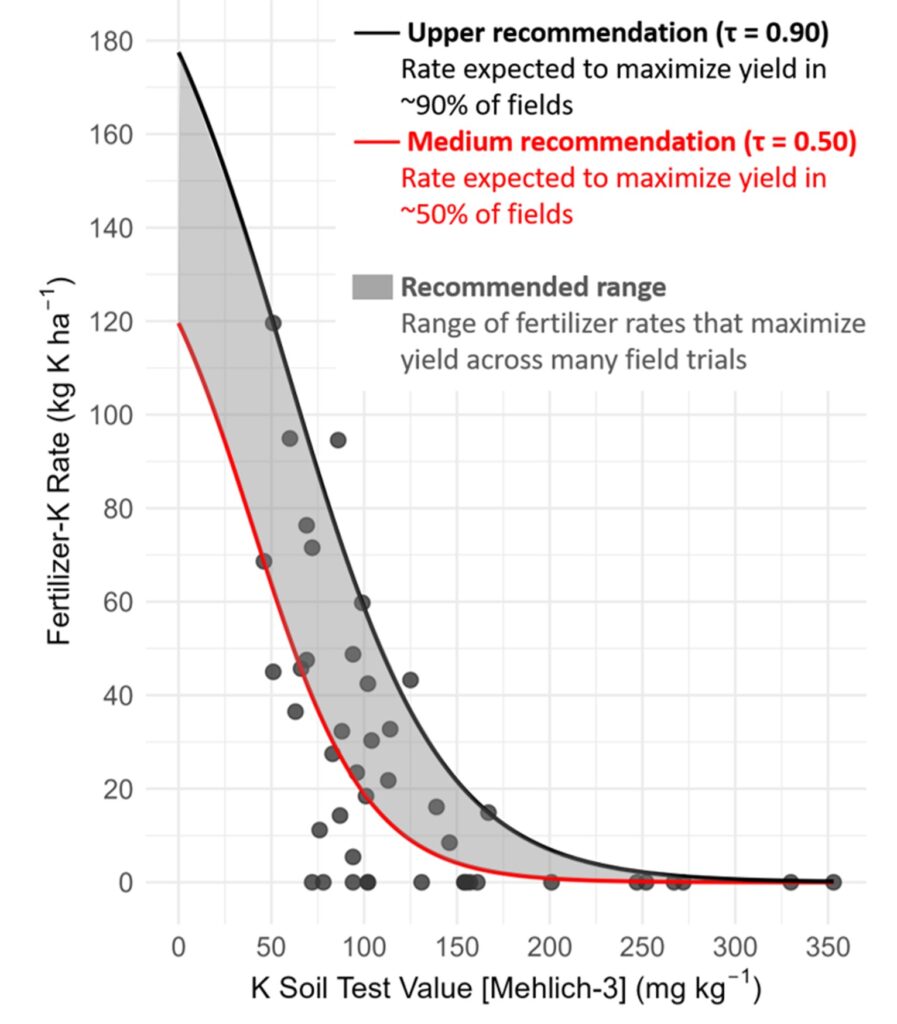
- Quantile regression produced smooth, data-driven fertilizer recommendation curves that reflected the range of crop responses observed across many field trials, resulting in recommendations that were statistically robust and agronomically interpretable (Figure 1).
- ENET showed unrealistically high fertilizer-nutrient rates at elevated STVs.
- CART produced stepwise recommendations, including abrupt declines and zero rates at higher-than-expected STVs.
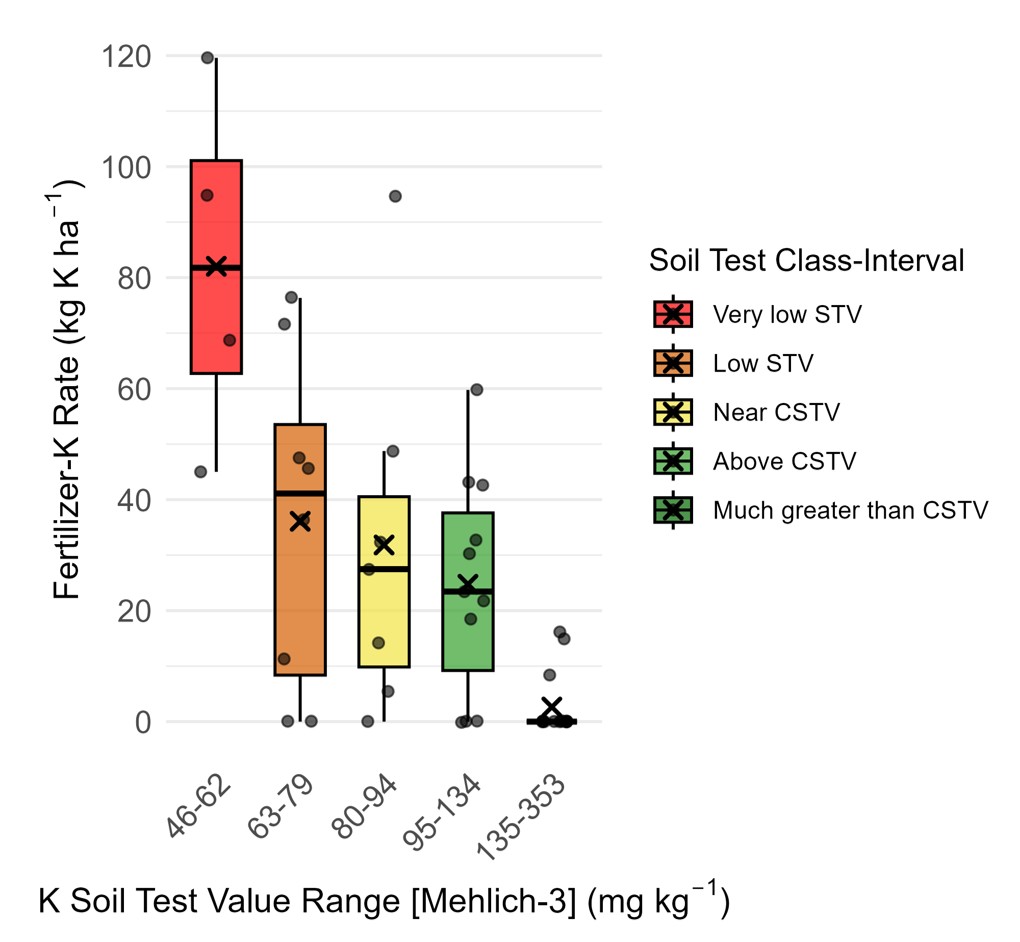
- Although STCI does not provide continuous fertilizer recommendation curves, it summarizes crop response data within soil test categories relative to the critical soil test value (CSTV), and it remains useful when datasets are too limited for reliable quantile regression (Figure 2).
For example, at a STV of 94 mg kg–1, quantile regression recommends approximately 22–65 kg K ha–1, depending on the acceptable yield risk (Figure 1), whereas STCI recommends a single rate of 27 kg K ha–1 (Figure 2).
Based on these findings, FRST selected quantile regression as the primary framework for estimating fertilizer-P and -K rates. For datasets that are too limited for reliable quantile regression, STCI will serve as a complementary framework.
The quantile regression framework provides the foundation for integrating economic optimization and probability-of-response tools within the FRST decision aid.
Special thanks to our funders, including USDA-NRCS (grant NR233A750011G016), the U.S. Department of Agriculture National Institute of Food and Agriculture, Hatch National Research Support Project NRSP11, and Hatch and Smith-Lever Funds.
For more information, visit soiltestfrst.org.
For more detailed information
Filippi, J., Gatiboni, L., Buol, G., Spargo, J.T., […], & Slaton, N.A. (2026). Soil test calibration frameworks for estimating fertilizer phosphorus and potassium rate recommendations for the Fertilizer Recommendation Support Team. Soil Science Society of America Journal. In review.
Authors: J. Filippi (Univ. of Arkansas), L. Gatiboni (NC State Univ.), G. Buol (NC State Univ.), J. Spargo (Penn State Univ.), D. Kaiser (Univ. of Minnesota), R. Singh (Univ. of Arkansas), M. Yost (Utah State Univ.) & N. Slaton (Univ. of Arkansas). August 2026