Fact Sheet # 11: Stakeholder Insights on Soil Sampling and Fertilizer Management Practices
Soil testing and fertilizer management are at the core of modern agriculture. Most soil test correlation and calibration trials and the corresponding development of fertilizer recommendations occurred from the 1950s to 1970s. Despite many changes and advancements in agronomy and higher crop yields, research on key soil fertility topics has not been conducted in many states. Today, the imperative of upgrading fertilizer and soil amendment recommendations is highlighted by variable on-farm economic conditions and concerns over the fate of fertilizer nutrients in the environment.
The Fertilizer Recommendation Support Team is a national initiative dedicated to improving the scientific foundation of soil fertility and fertilizer recommendations across the United States. Researchers working as a national team rather than within individual states and institutions will reduce ambiguity while optimizing soil amendment and nutrient use across state lines. FRST activities also include the improvement of soil acidity management and liming recommendations. The FRST tool and data generated by FRST activities are expected to augment existing recommendations with the potential to enhance soil and natural resource management, increase return on fertilizer and soil amendment investment by growers, and reduce nutrient losses to the environment.
To gain a better understanding of stakeholder practices, perceptions, and needs, the FRST team, in conjunction with Agricultural Laboratory Testing Association (ALTA) leadership, conducted a survey of growers and advisors. The survey had 33 questions and two sections. This fact sheet focuses on the eight questions in the survey’s second section to understand the effect of land ownership on fertilization practices, and soil sample depth, collection month(s), frequency, method (zone vs. grid), and the percentage of land receiving variable rate fertilization.
The survey was distributed via X (Twitter), shared with FRST collaborators, and emailed to Certified Crop Advisors through the American Society of Agronomy. The survey results were summarized by categorizing respondents by geographic region (Northeast, n = 7; North Central, n = 74; South, n = 42; West, n = 37) or occupation (farmers, n = 13; independent crop advisors, n = 68; industry agronomists, n = 75; public-sector professionals, n = 21).
The main findings about soil sample collection practices include:
There was no consensus among occupation groups or regions about how land ownership (owned vs. rented/leased) influenced fertilization decisions. Farmers generally reported similar fertilization decisions for leased and owned acres, although the sample size was small. North Central respondents were most likely to manage owned and leased land differently.
- There was no consensus among occupation groups or regions about how land ownership (owned vs. rented/leased) influenced fertilization decisions. Farmers generally reported similar fertilization decisions for leased and owned acres, although the sample size was small. North Central respondents were most likely to manage owned and leased land differently.
- In the Northeast, North Central, and South regions, soil samples are generally collected once every 3-4 years. In the West, samples are most often collected annually.
- Soil samples are typically collected from the 0-6-inch depth in all regions except the West, where the 0-12-inch depth was the most common. Samples from the 0-8-inch depth were common in the Northeast and North Central regions, where it is sometimes the recommended depth.
- Crop rotation sequence (19%), soil test phosphorus and potassium (14%), and crop yields (13%) drive sample frequency decisions.
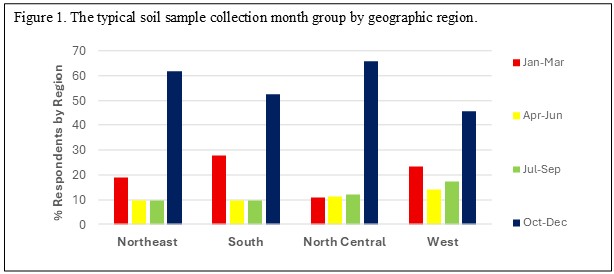
- Soil sample collection is usually performed in October (25%) and November (24%), followed by September, December, March, and April (~10% each) across all regions and occupations (Figure 1).
- Respondents in the North Central (70%) and South (46%) regions use grid or zone sample methods across 50 to 100% of their managed acres.
- Despite the widespread use of grid and zone sampling, the respondents in the North Central region use variable rate fertilization for phosphorus and potassium on only about two-thirds of the acres that are grid and zone sampled.
For more information, visit soiltestfrst.org.
Special thanks to all survey respondents and our funders, USDA-NRCS (grants 69-3A75-17-45 & NR233A750011G016), USDA-ARS (grant 58-8070-8-016), and agInnovation via Hatch Funds from the National Institute of Food and Agriculture, U.S. Department of Agriculture for National Research Support Project 11.
For more detailed information
Bourns, M., Osmond, D., Slaton, N.A., Spargo, J.T., Gatiboni, L., Lacey, C., Sawyer, D., & Yost, M. (2026). Stakeholder engagement with soil testing: Practices and perspectives in U.S. agriculture. Agronomy Journal, 118, e70379. https://doi.org/10.1002/agj2.70379
Bourns, M.A., Osmond, D.L., Slaton, N.A., Spargo, J.T., Gatiboni, L., Lacey, C., Sawyer, D., & Yost, M. (2025). Stakeholder engagement with soil testing: Practices and perspectives in U.S. agriculture [Data set]. Ag Data Commons. https://doi.org/10.15482/USDA.ADC/29656808
Authors: M. Bourns (Purdue Univ.), N. Slaton (Univ. of Arkansas), D. Osmond (NC State Univ.), L. Gatiboni (NC State Univ.), J. Spargo (Penn State Univ.), & M. Yost (Utah State Univ.). May 2026.